If you have noticed sap oozing, sometimes frothy, down the side of your trees they may be suffering with slime flux.
Continue readingCategory Archives: Pests
Deer Management in Gardens
On Wednesday, July 27, the Horticulture Webinar Wednesdays presents a training on Deer Management in Gardens with Matt Springer, UK Wildlife Specialist. The webinar begins at 12:30 pm EST/ 11:30 am CST.
Register for the meeting here.
See what other webinars are coming this season here: https://kentuckyhortnews.com/horticulture-webinar-wednesdays/season-three/
View Season Two webinars here: https://kentuckyhortnews.com/horticulture-webinar-wednesdays/season-two/
View Season One webinars here: https://kentuckyhortnews.com/horticulture-webinar-wednesdays/season-one/

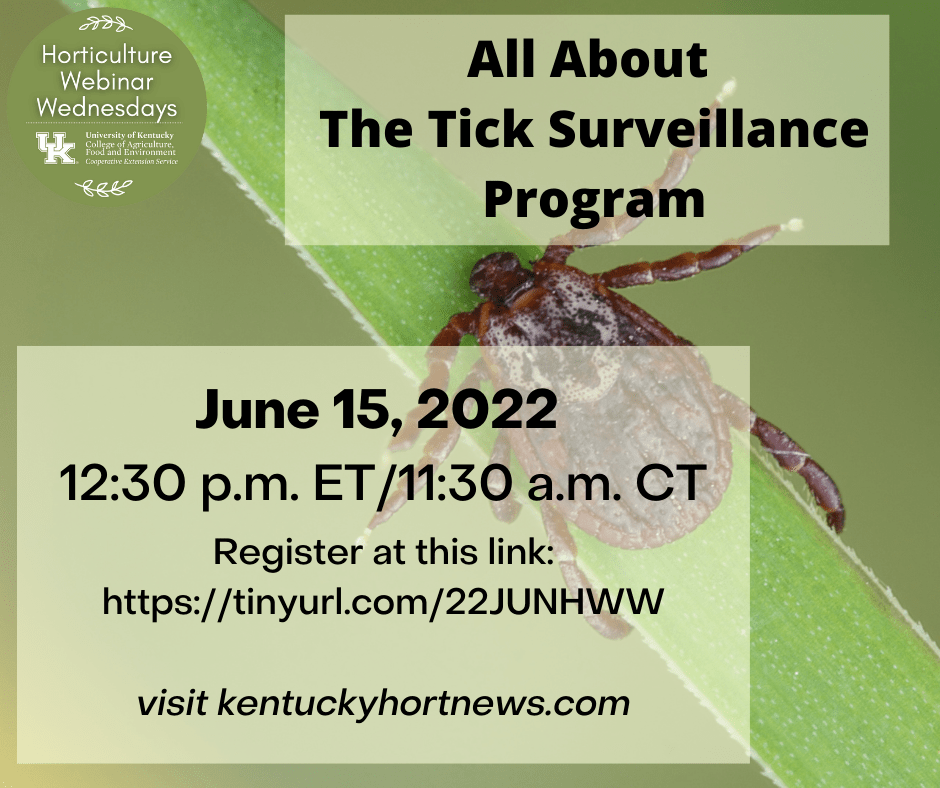
The Tick Surveillance Program
On Wednesday, June 15, the Horticulture Webinar Wednesdays presents an update on the UK Tick Surveillance Program with Dr. Jonathan Larson, UK Entomologist. The webinar begins at 12:30 pm EST/ 11:30 am CST.
Register for the meeting here: https://tinyurl.com/22JUNHWW
See what other webinars are coming this season here: https://kentuckyhortnews.com/horticulture-webinar-wednesdays/season-three/
View Season Two webinars here: https://kentuckyhortnews.com/horticulture-webinar-wednesdays/season-two/
View Season One webinars here: https://kentuckyhortnews.com/horticulture-webinar-wednesdays/season-one/
The Convict Caterpillar
One August, these unknown critters were thoroughly devouring every part of my spider lilies, actually leading to pure devastation. I have only two small established groupings. Did I know what they were?
Continue readingMoles and Other Pesky Diggers
On Wednesday, June 16, the Horticulture Webinar Wednesdays presents a training on Moles and Other Pesky Diggers with Kelly Jackson, UK Horticulture Agent in Christian County. The webinar begins at 12:30 pm EST/ 11:30 am CST.
Register for the meeting here: https://tinyurl.com/peskydiggers
See what other webinars are coming this season here: https://kentuckyhortnews.com/horticulture-webinar-wednesdays/season-two/
View Season One webinars here: https://kentuckyhortnews.com/horticulture-webinar-wednesdays/season-one/

Honey Bee Swarms
Throughout the month of May is prime swarm season for honey bees. If you are a bee keeper you might be very excited about this. Otherwise, the thought of a swarm of bees ascending in your yard can be quite intimidating. Have no fear, swarms of bees tend to be very docile as they are on a mission to find a new home.
Continue readingMossy Lawns
Moss in a lawn is not necessarily a bad thing. Usually moss becomes established in lawn areas where turf is thin or nonexistent. This may be a shady or full-sun site that remains wet for long periods of time. Areas with poor surface drainage, like low spots that collect water, or poor air circulation found next to buildings or wooded lots may also have moss. In these cases, it is not so much that the moss is crowding out the grass but rather the moss is filling in as the grass thins out.
Continue readingWhat’s Eating Your Evergreens?
Is something devouring your evergreens? Look closely, the culprit may be camouflaged and right in front of you! Bagworms are caterpillars that make distinctive spindle-shaped bags on a variety of trees and shrubs throughout Kentucky. They attack both deciduous trees and evergreens, but are especially damaging to juniper, arborvitae, spruce, pine and cedar.
Continue readingPlant Disease Resistant Cultivars
Do you have problems with fire blight, black spot, powdery mildew, Fusarium wilt, early blight, and late blight? If this is the case, plant disease resistant varieties this year! Sure old time favorites are what you are used to but try something different with them this year. Mail order catalogues promise a bountiful harvest of fruits and vegetables without much work, but we all know that isn’t how it works. However, there is one thing that we can do easily that will save us a lot of hassle this summer, variety selection.
Continue readingSpring Lawn Tips
Fescue lawns in Kentucky can struggle by the end of the summer with drought, disease, and even insect problems. Often our fescue lawns are thin and needing some nitrogen by the time fall arrives. September and October are the best times to overseed and fertilize your lawn but some maintenance practices can be done in the spring.
Continue reading Kentucky Hort News
You must be logged in to post a comment.